
Putting AI To Work in Healthcare: Analytics for Safer, More Responsive Hospitals
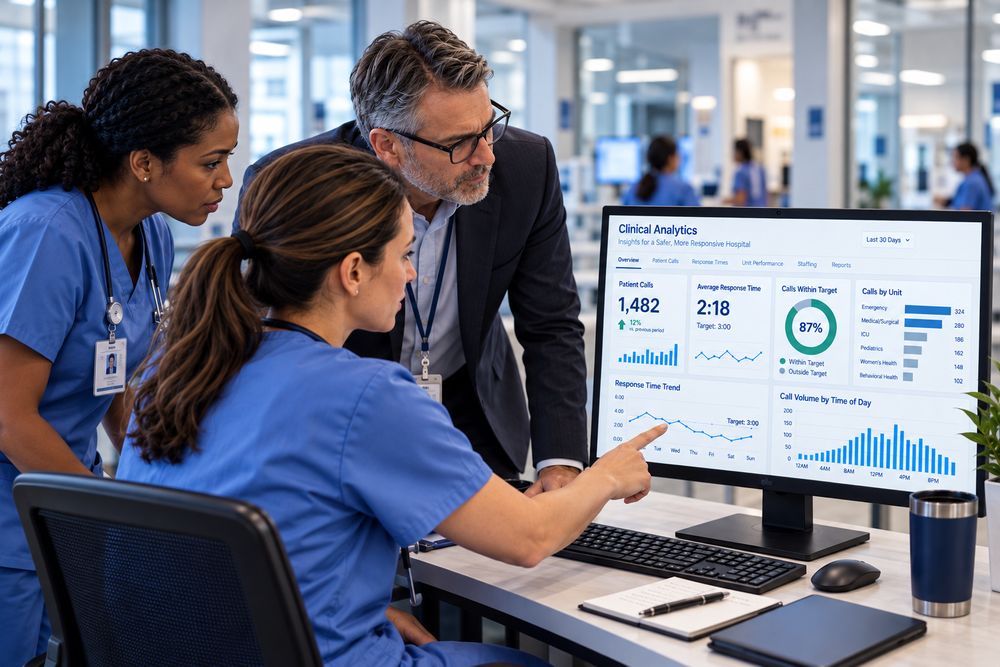
A patient presses a call button at 2:07 p.m. The call is answered three minutes later. Another patient generates a clinical alert during shift change. A staff duress event occurs in the emergency department. Each event produces data, but isolated timestamps tell hospital leaders very little about the operational conditions behind them. Putting analytics to work in healthcare means connecting those signals, identifying patterns, and giving clinical and security leaders information they can use to change staffing, workflows, response protocols, and resource allocation.
Hospitals already generate enormous volumes of operational data. Nurse call, patient monitoring, RTLS, staff duress, access control, video surveillance, environmental monitoring, and other systems continuously record activity. The opportunity lies in transforming that activity into operational intelligence.
Look beyond average response time
A report showing a three-minute average nurse call response can conceal the information a nursing manager actually needs. Which unit routinely exceeds its response target between 6 and 8 p.m.? Which call types generate the longest delays? Does response performance change during shift transitions? How often do calls require reminders? Are delays concentrated in particular rooms, days, or staffing configurations?
Integrated healthcare technology can capture and correlate information from multiple clinical systems, giving leaders the data needed to evaluate workflows and identify improvement opportunities. Data analytics can track staff presence, response times, time spent in patient rooms, and last known staff locations, providing measurable insight into how resources and workflows affect patient response.
That granularity changes the conversation. Instead of concluding that “response needs improvement,” management can isolate the conditions associated with slower response and determine whether staffing, assignments, escalation rules, or workflow design should change.
Turn clinical events into operational intelligence
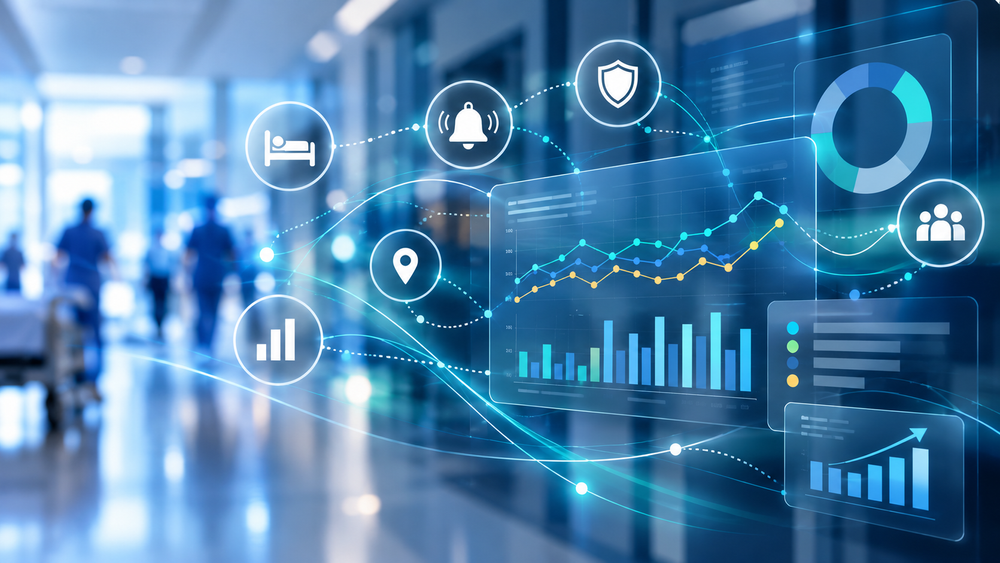
Analytics can add another layer of intelligence by bringing together data and events from multiple clinical and operational systems. Advanced tools can filter and prioritize alerts, automate redirection and escalation, route notifications based on staff roles, coordinate tasks and messaging, and capture performance data to identify response patterns and opportunities for workflow improvement.
Those capabilities matter because the volume of alerts alone is a poor measure of operational performance. Context determines whether an event represents routine activity, an emerging workflow problem, or a potential patient-safety issue.
Clinical analytics can examine call quantity, alert type, shift, nursing unit, room, bed, average response time, maximum response time, exceptions, and the percentage of calls answered within established targets. Managers can then compare actual performance against defined goals rather than relying on anecdotal feedback.
Staff presence data adds another dimension. RTLS integrations can automatically record caregiver arrival and time spent with patients, producing objective response information that can support staffing and resource-allocation decisions.
Apply the same mindset to hospital security
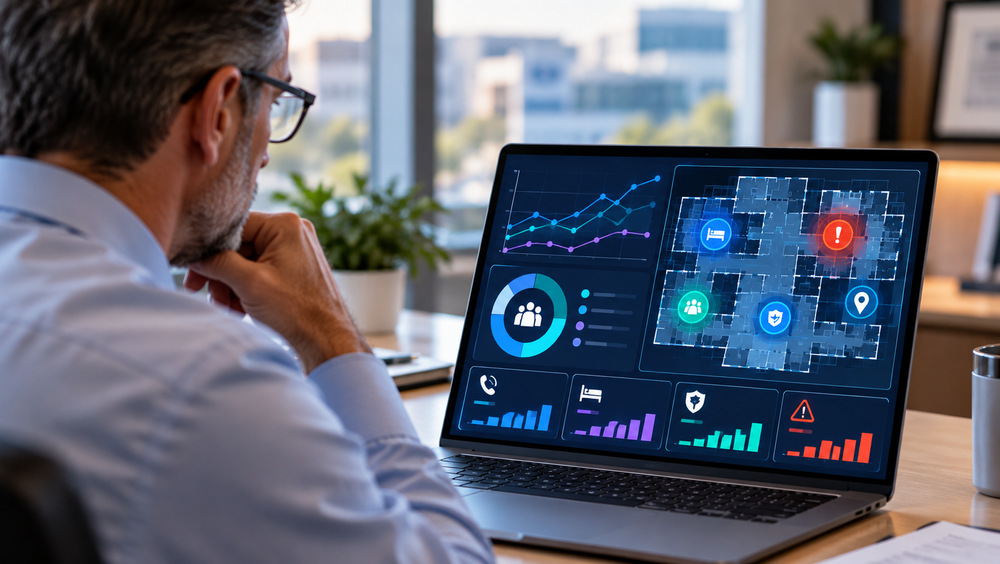
Security departments face a similar data problem. Access events, duress activations, weapons screening alerts, video events, incident reports, and response activity may reside in separate systems. Reviewing incidents individually can identify what happened. Analyzing patterns can reveal where operational exposure is developing.
For example, repeated duress events in one department warrant a different response than the same number of events distributed randomly across a campus. Security leaders can examine location, time, incident type, response interval, staffing level, and recurring behaviors to determine whether the pattern points to a coverage gap, environmental condition, procedural weakness, or training need.
AI can accelerate that analysis by surfacing correlations across large datasets that would be difficult to identify manually. Human review remains essential. A statistical pattern provides a reason to investigate. It does not automatically explain why the pattern exists.
Measure the workflow, not just the technology
Healthcare technology performance is often evaluated at the device level: Did the call button work? Was the alert delivered? Did the duress device activate? Operational analytics asks a harder question: What happened next?
A technically successful alert that remains unanswered beyond the hospital's target still represents a workflow issue. An alert routed to an unavailable clinician can expose an assignment problem. Repeated escalations may indicate insufficient coverage or poorly configured routing rules. Tracking alert delivery, acceptance, unhandled events, escalation, and subsequent activity gives organizations the data needed to examine the entire response sequence.
Use data to decide what to change
Nurse call, RTLS, staff duress, security, and clinical communication systems can generate measurable operational data across the care environment. AI and data analytics can correlate those events to show clinical and security leaders where response breaks down, where staffing or resources are misaligned, and which workflow changes warrant further evaluation.
Putting AI to work in healthcare should produce something more useful than another dashboard. The objective is a measurable change in how the hospital operates: faster response, more accurate staffing, better escalation, reduced risk, and clearer visibility into the events that affect patients and staff every day.
How much more could you learn from the data your hospital already generates? Contact TRL Systems at trlsystems.com/healthcare-clinical-solutions about putting AI and data analytics to work across your clinical and security operations.
